
The CEE Advantage
How Automation & Proximity Are Transforming Europe’s Supply Chain Landscape
17.12.2025 | Whitepaper by Julian Maasmann, Partner & Director, Member of the Board, Miebach, and James Fitzgerald, Regional Industrial Director, iO Partners
Executive Summary
|
Central and Eastern Europe (CEE) has moved from a promising alternative to an essential component of Europe’s future supply chain networks. Once valued primarily for low-cost labour, the region is now recognized for robust infrastructure, strategic location, skilled workforce, and accelerating automation.
Today, multinational manufacturers, retailers, and logistics providers view CEE not as Europe’s “nearshore” extension but as its operational heart. Czechia, Poland, Slovakia, Romania, and Hungary attract sustained investment because they deliver what modern supply chains require: resilience, cost efficiency, and agility, all within close reach of Europe’s largest consumer markets.
As labour costs rise and technology matures, automation is the defining catalyst. At the heart of these changes is Czechia’s consistent rise as a location for manufacturing, logistics and innovation.
The mix of affordability, innovation, and geographic advantage positions CEE as Europe’s next logistics powerhouse. |
Regional Industrial |


Why CEE is hot and attractive
|
CEE is proving its strength in 2025, balancing steady growth with adaptability in a shifting global landscape. Consumer spending remains strong, supported by rising incomes and sustained EU investment, while trade agreements earlier in the year (namely the US-EU tariff deal) helped stabilise key manufacturing sectors. Despite persistent global uncertainties, the region’s diversified economies, competitive labour base, and deep integration into European supply chains keep its growth trajectory ahead of Western Europe.
In 2026 and beyond, CEE’s outlook is bright: rising demand, strategic nearshoring opportunities (especially from Asian occupiers), and accelerating investment in green mobility and infrastructure position the region as a critical growth engine for Europe. Inflation is moderating, labour markets remain dynamic, and long-term prospects continue to outperform the Eurozone average. |
CEE is emerging as Europe’s front-runner, combining resilient growth, strong demand, and rising nearshoring activity to outpace Western Europe in 2025 and beyond. |
Across Europe, companies are reassessing production and logistics footprints amid cost pressures, geopolitical uncertainty, and the need for resilient networks. In this context, CEE has emerged as a clear front-runner.
A survey of 130 companies active in the region highlights CEE’s strongest advantages.
Fig. 1: Location benefits of CEE according to 130+ companies surveyed
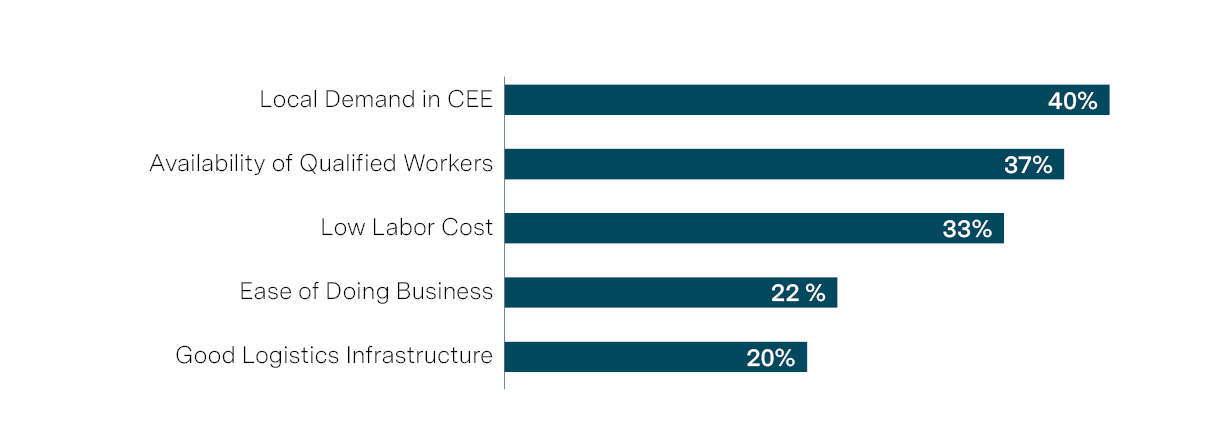
Source: KPMG Germany and “Ost-Ausschuss der Deutschen Wirtschaft”
Beyond that, the region’s integration into the EU single market, proximity to Western Europe, and mature industrial ecosystem create high business confidence with low operational friction.

|
Read more in the
|
Would you like to get more insights on the CEE Advantage or are you looking for a partner to support you in your supply chain project? Please get in touch with us!
Contact

Germany
Julian Maasmann
Director, Head of Business Unit Process Industry, Head of Industry Consumer Goods