

Supply Chain Profile Definition
Introduction
Supply chains need to be adapted specific customer needs, cost structures, and service expectations. Without a clear understanding of supply chain profiles, businesses risk making decisions that are not in line with the requirements in the areas of e.g. network design, production, operating models, and technology investments. Understanding each supply chain profile is crucial in making the right decisions for supply chains that matter.
Supply Chain Profile Definition is an important process that helps companies understand the diversity and complexity of their supply chain flows. It starts from a simple idea: not all products, customers, and orders exhibit the same characteristics, so they should not be planned and served the same way. Some demand is stable and easy to forecast, while other demand is volatile. Some orders are frequent and small, others are large and infrequent. Some products are easy to store and ship, while others require special handling, strict lead times, or complex fulfillment.
In a profile definition, these differences are made visible by combining data analysis with business input. Companies typically assess key “drivers” of complexity and cost, such as demand variability, service and lead-time expectations, order size and frequency, product characteristics, sourcing constraints, and logistics requirements. Based on these factors, supply chain flows are grouped into a small number of clear profiles that describe how different parts of the business actually move through the supply chain.
Supply chain profiles create a 'shared language' across sales, operations, planning, and logistics, and they show where a one-size-fits-all setup creates unnecessary cost or service issues. This enables companies to design fit-for-purpose solutions for each profile, such as differentiated service models, tailored inventory and replenishment rules, more effective planning processes, and targeted network and warehouse improvements. It forms the strategic groundwork for network design, planning processes, service model differentiation, and cost-to-serve optimization.
How do we define a client’s supply chain profile?
Data-driven segmentation, brought to life
In Data Collection & Initial Segmentation, we analyze real transactional data to uncover product flows, customer behaviors, and operational patterns. These insights drive the initial segmentation of your supply chain.
In Business Contextualization, we validate and refine segments through collaborative workshops. This ensures alignment with your strategic priorities and operational constraints.
During Profile Development, we define a focused set of supply chain profiles, each with distinct characteristics and performance needs.
In Flow Mapping & Visualization, we connect each profile to its end-to-end supply chain processes. This makes differences in flow and logic easy to see and act on.
In Link to Strategic Decisions, profiles serve as a decision-making lens to guide network design, operating models, and investment priorities with consistency and clarity.
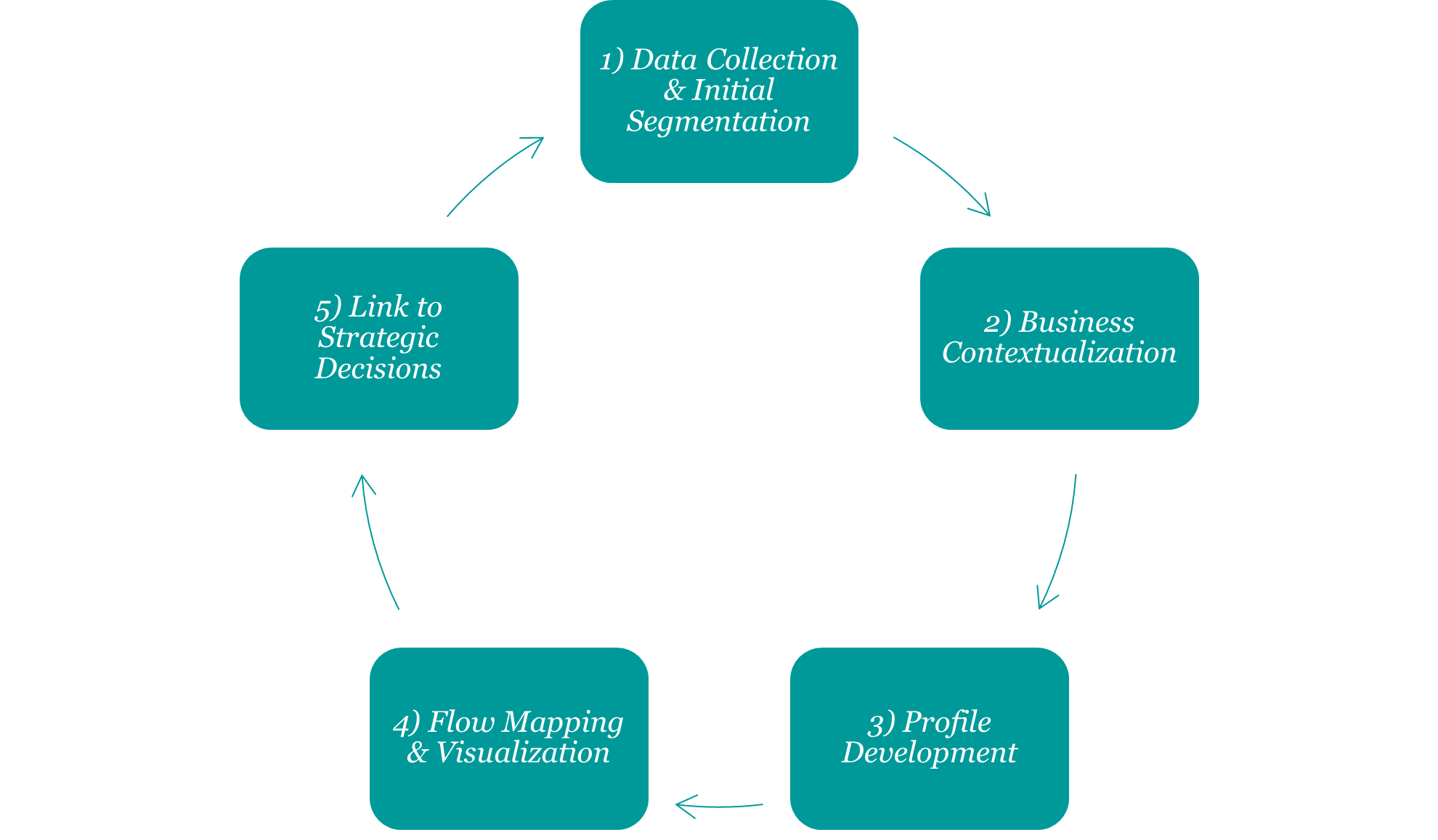
Figure 1: Data-driven Segmentation
Typical Criteria that are important in this process

Flow Characteristics
Order frequency, volume/weight, lead time, variability, batch size

Product Attributes
Value, lifecycle stage, shelf life, customization level

Customer Requirements
Service level, delivery frequency, packaging needs, regional preferences

Sourcing & Production
Make-to-Stock vs. Make-to-Order, internal vs. external production

Fulfillment Model
Centralized vs. decentralized, B2B vs. B2C, direct vs. indirect

Regulatory/Market
Compliance needs, export/import controls, localization

Strategic Relevance
Contribution to margin, market differentiation, strategic initiatives
Relevance of Supply chain profile definitions
Companies are shifting from one-size-fits-all supply chains to modular, hybrid, and demand-driven networks. This requires a more nuanced understanding of supply chain profiles that go beyond classic ABC/XYZ segmentation.
- Increased focus on supply chain segmentation and personalization
- Greater demand for agile supply chain models in response to disruptions
- Integration of supply chain profiles into digital twins and simulation tools
Well-defined SC profiles create transparency and alignment across the business. They serve as a strategic bridge between corporate goals and operational design choices. Rather than forcing all flows into a one-size-fits-all model, organizations can tailor their networks, processes, and technologies based on the real demands of their market and operations.
Capability Insights




The Miebach Difference
Miebach combines decades of cross-industry expertise in supply chain modeling with a proven, structured methodology for defining supply chain profiles that bring together robust data analysis and actual business insight. We integrate qualitative and quantitative inputs end-to-end, from customer segmentation and stakeholder perspectives to actual order-flow analytics, using rigorous but customizable profiling templates.
What sets Miebach apart is the clear tie between profiling outcomes to measurable value, for example quantifying cost-to-serve differences, and to downstream decisions such as network design, planning processes, and digital tool enablement. Backed by hands-on experience facilitating cross-functional alignment across logistics, sales, and operations, and delivering global rollouts in complex organizational environments, we balance strategic ambition with practical implementation readiness.
What can we help you with?