
Limitations of 2D Design Thought Leadership
02.12.2025
2D Makes Everyone a Mind Reader (and that’s a problem)
The limitations of solely relying on 2D drawings for facility design
It’s time to admit it: 2D drawings no longer tell the full story that decision-makers need to confidently sign off on new facility designs. For decades the industry has relied on CAD drawings and PDF layouts as the default language for communicating functionality. While these drawings remain essential for technical accuracy later in the project, they simply don’t give teams a meaningful picture of the future during the design phase, when clarity matters the most.
2D Requires Too Much Deciphering
Interpreting a 2D plan means constantly jumping between views, legends, and separate pages just to understand what’s happing in the space. No single view gives a clear picture of the design and every important detail must be hunted down somewhere else in the drawing.
For warehousing, traditional overhead views fail to convey details like racking levels and conveyor heights without requiring a slew of symbols and annotations. Complex, multi-level conveyor systems are flattened on top of each other, entirely erasing the nuances of each layer. The same is true for buildings with multiple floors. Each level must be drawn separately to avoid unreadable overlap, but this limits how continuity between floors is understood.
Even material types and finishes require a separate legend to relate stylistic details to the layout. And still, these confusing tables of colors and patterns fail to provide a clear picture of what the space will look like. The constant switch between looking at the layout and tracking down design notes practically guarantees that aspects will get lost in translation.
Stakeholders Don’t See the Same Picture
2D layouts force viewers to mentally reconstruct a 3D space from lines, symbols, and annotations. Variations in background and expertise promise that each stakeholder will imagine different versions of “the same plan.” This creates false sense of alignment during project meetings that is built on these mismatched expectations.
Gaps in clarity from the 2D drawings are frequently filled with assumptions. Without confirmation from additional views, reviewers may falsely assume that clearances are adequate, utilities do not conflict with the equipment, and workstations are ergonomically appropriate. These unspoken assumptions quietly compound into further misalignment throughout the project. As a result, the review process becomes longer and more iterative as teams work to reconcile differences that stem from the limitations of 2D rather than from the solution itself.
The Narrative Gets Buried in Symbols
While 2D drawings are still effective for communicating technical aspects of a solution, they only depict a facility as a set of lines and symbols rather than as an environment where people will work, solve problems, and interact with equipment. These flat drawings strip away the human and operational narrative because they struggle to communicate scale, reach, or interaction points in a meaningful way.
As a result, non-technical stakeholders often disengage, quickly losing the connection between the solution and what it means for them. This happens not because they lack interest, but because 2D isn’t an intuitive medium for grasping spatial orientation or user experience.
This gap becomes even more consequential at the executive level where leaders are asked to approve multi-million-dollar investments without a complete understanding of how the facility will operate, evolve, or deliver value. Without a compelling narrative that brings the future environment to life, critical questions about scalability, work environment, and feasibility become more difficult to understand simply because the medium struggles to tell the story.
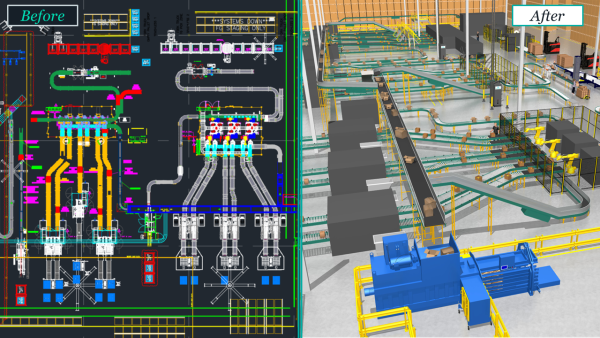
2D design versus 3D rendering
Better Decisions Require Better Visibility
As facility design evolves to new levels of complexity and investment stakes rise, relying solely on 2D drawings introduces unnecessary risk. Flat plans can document the technical layout and footprint but they do not provide the clarity that these projects require to keep cross-functional teams aligned. As a result, misalignment surfaces too late, critical considerations go unseen, and stakeholders end up making decisions without complete context.
To design with confidence, teams need tools that illustrate the full environment and not just the footprint. Visualizing the interactions and spatial relationships that are lost in 2D strengthens alignment, reduces risk, and keeps stakeholders better informed. Successful facility design depends not just on accuracy, but on clarity, and achieving that requires moving beyond the inherent limits of 2D.
Author